Indignation publique
Les liaisons dangereusesIndignation publique names a form of collective moral judgment that supplements legal punishment: the public ridicules faults and expresses indignation at vice. The novel puts this principle on display in the hostile reception of the Marquise de Merteuil, but its defense of public censure also stresses how unevenly society applies it, sometimes welcoming and honoring people whose conduct resembles that it condemns.
Public Judgment Beyond the Law
In a letter discussing Molière’s Tartuffe, the author distinguishes legal punishment from public judgment. Tartuffe, he argues, is punished not by the laws but by authority; the public’s proper justice begins where government has not undertaken to punish. Its responses are differentiated: ridicule is the sanction for faults, indignation the response to vice. This account makes public feeling a moral remedy, not a substitute for every legal process.
The letter also presents indignation as a force capable of awakening judgment where society has grown tolerant of vice. The public outcry against the Marquise de Merteuil and Vicomte de Valmont is offered as a contemporary instance, but not as proof of consistent standards. The author points to comparable figures who have been received even more warmly and honored, and says he omitted some recognizable, recent examples rather than expose particular people. The distinction is telling: public condemnation may make vice visible, while social acceptance can still protect those who practice it.
Merteuil’s Public Humiliation
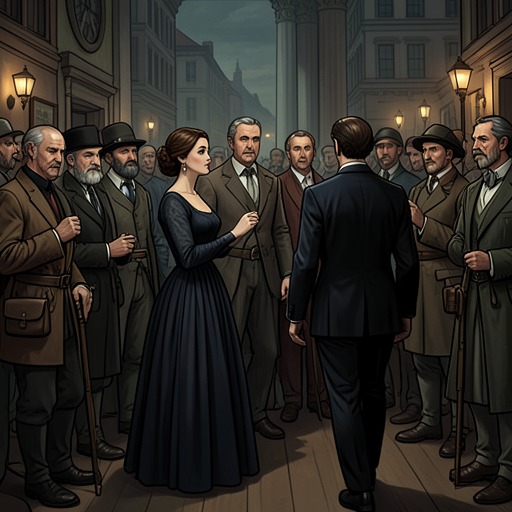
The episode at the Italian Comedy turns collective judgment into a scene. After arriving from the countryside, the Marquise de Merteuil attends the performance alone in her box. In the crowded small salon afterward, murmurs rise as she enters. She takes an empty place on a bench; the women seated nearby then rise together, leaving her by herself. The men applaud this conspicuous withdrawal, and the murmurs reportedly grow into jeers.
The arrival of M. de Prévan sharpens the reversal. He has not appeared publicly since his own affair, but when he enters the salon, men and women gather around him and applaud, effectively carrying him toward Merteuil as the crowd forms a circle. Merteuil is said to keep an unchanged expression, though the account itself doubts that detail. The confrontation lasts until her carriage is announced; as she leaves, the jeering intensifies. In the same account, Prévan is warmly received by officers of his corps, and people expect him soon to regain his position and rank. The episode thus sets Merteuil’s isolation against Prévan’s welcome, rather than showing public censure falling evenly on both.
Censure, Reputation, and Its Limits
The salon’s gestures make indignation legible without a formal sentence: women leave the bench, men applaud, and the crowd turns the arrival and departure into a public spectacle. The scene echoes the letter’s distinction between law and social justice, but it also reveals the instability of that justice. The same public that humiliates Merteuil celebrates Prévan, while the letter observes that people resembling the novel’s condemned figures have elsewhere been honored. Collective opinion can punish, but its verdict is neither uniform nor necessarily durable.
The author defends depicting conduct that readers should resist, including the calculated vices of women able to exploit rank or fortune and to heighten those vices with intelligence and charm. He describes public indignation as useful for stirring opposition to such behavior, while acknowledging the troubling gap between moral condemnation and social reward. In this conception, Indignation publique is both a sanction enacted in public and a fragile ethical standard whose force depends on what a society chooses to notice, applaud, or shame.